Panama's geographic location

Panama is located southeast of Central America, bordered on the north by the Caribbean Sea, south by the Pacific Ocean, east by Colombia and west by Costa Rica. Its Capital is Panama city.

It is a place meeting of several cultures. In its territory is located the Panama Canal, an important work that facilitates shipping between the Atlantic coast and the Pacific Ocean and has a great influence on world trade. Due to its geographical position currently offers the world an extensive platform of marine services, commercial real estate and financial services, where we highlight the "Zona libre de Colón", second in the world.

Its population exceeds by some three million inhabitants, which boasts a privileged position in various statistics of growth and development in Latin America, as per capita income, level of economic growth, globalization and life expectancy.


Showing posts with label tours. Show all posts

Boquete-Chiriquí:

Panama-Boquete-Chiriqui-Baru volcano
Baru volcano


Panama-Boquete-Chiriqui


Panama-Boquete-Chiriqui


Boquete-Panama


Boquete-Chiriqui-Panama


Boquete is a small and beautiful town located in the Chiriqui Province, Panama. This site has abundant natural resources like mountains covered by primary and secondary forests, an extraordinary fauna diversity, singing creeks of crystal clear waters, a majestic volcano, impetuous rivers, national parks and forest reserves.

The tour options are numerous, the more important ones: trek in the forests, visiting the local attractions, canopy, kayaking, river rafting, ascent to the top of the Baru Volcano, visits to La Amistad International Park, walking along Boquete's main street, or simply birds and fauna watching. Boquete is a place that it will surprise you. It has a fresh (sometimes cold) temperature, no big storms, and excellent air and land connections.

The Barqueta Beaches-Chiriqui:


“Playa La Barqueta”:  This beautiful beach situated on 18 miles of beautiful Pacific Oceanfront is located just 25 minutes from the city of David. La Barqueta rental villas, vacation homes, and condo rentals are starting to become available along the beach. "Playa La Barqueta" is known for “Las Olas” a 5 Star Beach Resort, built in 2001. This beach is surrounded by high biodiversity. Surfing, beach walking, fishing, bicycling, kayaking, birding and shelling, are all available here. 


Image-Barqueta-Chiriqui-Panama


Barqueta-Chiriqui-Panama-Las Olas Hotel


Barqueta-Chiriqui-Panama-Image


Veraguas Fair´s in Soná:


The Industrial, Tourism, Agricultural, and Craft Fair of Veraguas held in “Soná”, is one of the most popular events of this region, which offers its visitors all of the necessary facilities and entertainment to make the event a success.
The fair includes from traditional dances with the best national artists to the hottest night clubs in the country, which combined with the exhibitions of all kinds of things and handicrafts, fair rides, the beauty of the landscape, good attractions, represent a significant reason to visit the town.

Adventures takes flight:


Before I go on vacation or visit a new destination, I always check for bird watching opportunities.  Venturing out for a glimpse of feathers and watching and studding wild birds is one of the most exciting, yet relaxing, of outdoor hobbies.
Birds are descendants of the two legged carnivorous dinosaurs of the  Jurassic era, and they are now distributed across all land and ocean biomes.  There are more than 10000 species of birds, with plumage running the gamut of colors and songs covering the musical spectrum, not to mention the extremely varied and odd courting behavior of the males.

The dances of the blue-footed boody, the flamingo, and the magnificent frigate  illustrate this point.  These fascinating animals (ranging in size from the two and a half-inch snowcap hummingbird  to the nine-foot-tall ostrich) are revered  in several cultures and even appear on the national coats of arms and flags of some countries.

Despite its small size, Panama boasts 972 species, other people say they are 976, making it a prized destination for bird watchers.  It is not surprising that it has eamed worldwide recognition for record numbers of birds sighted in a twenty-four hour period.  The central region is one of  the most accessible and bird-rich in the country.  Observation points like the Panama Rainforest and the Metropolitan Park are less than half an hour from the capital.

Ten basic rules of surfing:


1.     If you want to go surfing with your friends and the place is crowded, don´t enter the water all at the same time, but go out separately. Do not make it look an invasion.  Do not paddle out straight to where everyone is, instead wait on the side for a while and take your time.

2.    Once at the line up, do your best to say, “hello” to others; even if nobody answers back. What really counts is your intention.

3.  Wait for your turn; do not paddle towards the inside for priority. If you look like you want to catch all the waves, don´t be surprised if others drop in
On you.  Do not be aggressive.

4. When you paddle for a wave... catch it! If you refuse to go without a good reason, the locals won´t give you another chance. Remember a wipe out is always better than a missing virgin wave. The really good waves don´t appear every second.
5. Respect priority. The surfer who stands up the closest to the peak has priority, even if you stand up first because you have a long board. If you drop in, don´t just disappear, apologize.

6. When you paddle back to the line up, be aware of the others. The ones surfing the waves have the priority over those paddling in. If you have the priority over those paddling in. If you have to change direction, always paddle to the with water, it´s the only means of leaving the way clear for those surfing.

7. Don´t yell after catching or losing a wave. Don´t keep calling your Friends. The majority of the surfers like to concentrate while waiting for sets and the shouting can be distracting.

8. Leave some waves for the others. Do not abuse of your priority, even more when you have the advantage of a longboard, evolutive board, or bodyboard.

9. When you are about to get worked by a set and have to let go off your board, be really careful that you don´t hurt someone  around you in the water.

10. Pick up few pieces of trash before or after each session. It is a win-win situation and you probably got somebody else thinking about doing the same thing.

The Centennial Bridge:

Imagen del instituto panamericano de turismo

The Centennial Bridge in Panama is a great bridge which is characterized by crossing the Panama Canal.  It was initially built to improve traffic uncomfortable Bridge of the Americas. And it was not until 2004 when it opened. Today is the second largest bridge used to cross the channel.
As such, it has a cable-stayed design with a length of 1.052 meters, 320 meters at the bow and a height of 80 meters above the Panama Canal, supported by two towers of 184 meters. The structure was designed to withstand the frequent earthquakes recorded in the area. Ultimately, the bridge receives 6 lanes of traffic

The tribe of the painted bodies:


Almost 7,000 indians from the Wounaan settlement share the jungle territory of Darien with their brothers Emberá.  The two cultures are very similar in idiosyncrasy, but speak different languages.  The Wounaan work the same handcrafts as Embera’s with the same extraordinary quality.  Women dress a skirt named paruma and usually topless, their bodies painted with intricated designs red and black.  They live near swamps; they fish and collect shrimps and oysters.  They use traps, arc and arrows, lance and blowpipes charged with poison arrows.

San Blas Islands:


The islands of the San Blas Archipelago of Panama are strung out along the Caribbean coast from the Golfo de San Blas to the Colombian border.  San Blas is a series of 378 islands of which only 49 are inhabited by the fiercely independent Kuna Indians.  A 20-minute plane ride away from Panama City.  The Kuna Indians, who have minimal interference from the national government, have maintained their own economic system, language, customs and culture, with distinctive dress, legends, music and dance. The area is surrounded by reefs, some of the oldest in the world, and offer wonderful snorkeling opportunities.
The Kuna Indians are known for their decorative art, known as molas. The Molas are usually very bright and vibrant are often used as costumes. Kuna women make rainbow colored fabrics, emblazoned with fish, jungle animals, birds, geometric designs.
You can stay at the Yandup Lodge or the Sapibenega Lodge which are both accessible via Playon Chico airstrip.   Furthermore to visit the villages of the Kuna Indians, or to take a guided snorkeling tour. Both hotels will provide you with guides for activities like this.  Snorkling is absolutely fantastic with many corals and lots of fish. It is recommended to bring your own gear. Diving is not allowed in San Blas.
The men fish from canoes as they did before Columbus came.  

"Bocas del Toro" Town


Diversity of cultures, colors, languages, customs, distinguish the Province of Bocas del Toro, located in the Republic of Panama. With an area of 4643.9 km ² and a population of 121,952 inhabitants, this region is characterized by its great tourist attractions.
Its origins go back among indigenous people and the influence of immigrants from the West Indies, Spanish, Chinese, German, French, British and Americans.  Hence, its main folk dances are Afro-Caribbean and Indian origin such as Calidonia, polkas and West Indian gangs.
Great writers are from the Panamanian province as the storyteller Jose Maria Sanchez, the novelist, poet and storyteller Tristan Solarte, and poets Harbar Eyra Thomas and Consuelo. Other artists are musicians: the pianist, composer and bandleader Luis Russell and composer, singer and ukelele player of the Lord Cobra.

Their culture and geography has greatly influenced the relations of production: in Changuinola, Almirante and Chiriqui Grande Guabito are agricultural.  Their population is mostly indigenous and bananas are the main crop, which brings huge profits to the country in export to the U.S. and Europe mainly.  Tourism´s services in the archipielago in "Bastimentos" and "Bocas Isla", also called Isla Colón, is known for tourism and fishing, its population is mostly Afro-Caribbean.

The rediscovery of this beautiful Panamanian province goes back to the fourth and last trip to America of Christopher Columbus made the October 6, 1502, from that time was part of the Government of Veraguas until 1821, when Panama became independent from Spain and joins the Great Colombia became the Department of Panama, then in 1903 happened the separation of Panama from Colombia. Part of its territory was given to the Shire Ngäbe Bugle in 1997.

International Tourism Expo:


In the second version of International Tourism Expo, the organizers hope to exceed sector expectations and receive 150 buyers from different countries, as well as some 4,500 local visitors. The event will contribute to the growth of the industry.
Countries such as Colombia, Puerto Rico, Mexico, Argentina, Brazil, Indonesia, Costa Rica, and several others will participate in the fair, which will include 150 exhibition stands located in Los Cayucos and the ATLAPA Islands.
Business meetings at the International Tourism Expo will be performed from 9: 00 a.m. to 4: 30 p.m., Friday, September 23. They will also be performed the next day, from 9: 00 a.m. to 12: 00 noon.  Admittance for the general public begins, running from 12:00 pm to 6:00 pm.

"Las perlas" archipelago:


“Las Perlas” is an amazing oasis:
Regarded as one of the most attractive island groupings in Panama with its abundance of unspoiled beauty, “Las Perlas” archipelago has a mysterious attraction that captivates visitors.   It is said that the name comes from the vast amounts of beautiful pearls that are found in the area.
Its beautiful white sand beaches attract hundreds of thousands of tourists from around the world. Its waters are calm, warm and shallow encouraging the reproduction of thousands of marine species.
 In fact, the famous Peregrina Pearl, owned by Philip II and later to the actress Elizabeth Taylor was found in this region.
No words can describe how much pure beauty can be found in the Pearl Islands.
 Possible stops include:  Contadora, Saboga, and El Rey Islands; All inhabited islands and the most popular destinations where you can view one of the world’s most beautiful sunsets.
 Uninhabited islands include:  Pacheca, Pacequilla and Bartolomé where you feel a dreamy sense and relaxation.
 However, the beauty of this region is not limited to the islands mentioned above.   This region extends to an area of over 1,165 square kilometers.  The activities can be practiced are several, diving and snorkeling in crystal waters and surfing, or hiking through the woods

Malena: An example in the protect of turtles


An unusual community, located in the middle of the country in the province of Veraguas decided to cut with ancestral tradition and stop the hunting of turtles and their eggs and create a team to protect them.
The Araucaria foundation trained the community so that, aside from looking after the turtles, they learned how to attract ecotourism guests.   MarViva gave the project their support and sponsored a nursery to help protect the egg nests. 
After much arduous digging in the sand, Malena´s turtles deposit more than sixty eggs in their nests.  They then cover the eggs and wait, in the hope that their progeny will survive.  The spawning mothers arrive little by little between July and August.  During the months of September and October spawning turtles are seen, practically on a daily basis.  The newborns start leaving at the end of August.
In 2002, the community of Malena, located in Panama´s Veraguas province, made a fundamental decision to protect the local turtle hunting , the gathering of turtle  eggs, and the massacre of the surviving baby turtles by pet dogs and other disturbances to the sand where the turtles nest.  Even though these species of turtles are considered endangered by CITES (Convention on International Trade in Endangered Species of Wild Fauna and Flora), human  actions hostile to turtles are still found in many coastal communities because of a lack of community education and failure to consider other food alternatives like chicken eggs.
Becoming a safe home for turtles was not an easy process for the Malena community.  In the beginning, it seemed almost hopeless, as a few lone visionaries fought against sand removal and made agreements with nearby communities to respect the nests.   Nine families took charge and since that time, they have taken turns walking over the egg-laying mothers and doing everything possible to care for the nests.
In 2006 , the MarViva Foundation stepped in to a support this model community by constructing a second nursery and a beach shelter for the patrolling guardians.  Marviva also trained children and adults to handle the nests, identify the turtles, and care for the nurseries.
Members of the nine families in charge of the project have subsequently traveled to various places inside and outside of Panama to train other Volunteers, visit similar model communities, and bring knowledge back to Malena.   Malenas´s community efforts have not been in vain; thanks to this community´s organizational skills and its desire to protect turtles at risk, eight to nine thousand newborn turtles have been released to the sea per year.  In
In 2008 the Malena turtles had a particularly good year:  14000 baby turtles had a made it to water.  It is hoped that many of these baby turtles will return to this beach years later as adults to complete the cycle.
Ecotourists  visiting Malena are treated to walks by lovely waterfalls and sightings of dozens of green iguanas that scamper freely, certain they are in no danger of being hunted.  The Malena community has also created a volunteer program that allows adventurous traveles and nature lovers the opportunity to help patrol the beaches, care for the nurseries, and release the turtles.  These activities are available during the nesting season,  which runs from June to November. 
The turtles have chosen Malena as the place where they will deposit their progeny-a vital part of their life cycle- and Malena as chosen in turn to proctect the turtles.  Working to pretect the turtles is satisfying for the guardians, and also makes this community an oasis in which is it possible to discover people living in harmony with their environment.   The example set by Malena gives visitors a new perspective, the community demonstrates ways to enjoy natural resources without destroying them.  Here, people have evolved from hunters turtle eggs and meat, to guardians of the beach.  By acting as ecotourism guides, these community members give outsiders the chance to witness the meaning of “life”, when they see dozens of little turtles emerge from the sand and struggle toward the sea. 

A new Coral species is discovered in Coiba:

Scientists from the Smithsonian Tropical Research Institute and the University of Costa Rica have identified a new coral species in 2011: Pacifigorgia  marviva, discovered at Coiba National Park in Panama.  This find increases the recorded number of this life form to a total of 35.  The twenty species in Panama represent more than half the species of this genus identified to date. The description of this new species was published in the “Journal of the marine Biological Association”, of the United Kigdom.   The Coral was named in honor to Erika Knie, whose love and passion for the ocean led her to create and preside over the Marviva Foundation, an international  NGO dedicated to the protection of marine life.  Her singular philanthropic vision and her continued support for the implementation of laws to protect marine resources inspired a change in their management at a regional level.

Guna Yala, Lemon Key:


Guna Yala-Panama


Guna Yala
Go to the islands of Kuna Yala is very easy, you need a car and take the Pan-American Highway, and to the entrance of Cartier, in Chepo, Turn left off the road.
  It is about an hour away to arrive to Kantule Niga´s dock, but be careful, because even though the road is paved, there are sharp curves and steep hills, can be dangerous. Cliffs, mountains, accompanied by the singing of the cicadas, streams and rivers (the bridge is already done) and a cool breeze is what you find along the way, which hopefully can even see endangered birds such as the toucan.
A few miles before you arrive, there is checkpoint Nusagandi, where you pay $ 5.00 per vehicle and $ 3.00 per person, there explains that he is entering territory district and then to give some recommendations of the road (curves and hills more pronounced, especially called Loma de la Iguana), they say that if you return the same day must do so before 4: 30 pm.
Upon arrival at the dock Niga Kantule is impressive to see how many cars and tourists, which are received by the Indians, who provide transport services boats to the various islands. There must pay another $ 5.00 per vehicle and $ 2.00 per person.
  The passage to the islands ranges from $ 15 (round trip) to the nearest such as Needle and Hook, which takes about 15 minutes. At the farthest as Elephant Dog and costs about $ 35, if you want go to the exclusives, invest up to $ 100.
The Lemon Key is formed by more than 20 Islands, there are beautiful beaches.   It is a good place for diving, snorkeling, playing volleyball, camping and fishing, for photography and adventure lovers.
 Its most famous Islands include: Dog Island, Devil Island, Herb Island and Pelican Island, among many others.
Among the most visited locations is the Sunken Ship, located on Dog Island. This is an ideal place of novice swimmers, since it is very near to the beach. You will find multi-colored reefs filled with fish, and the impressive Dog Island Beach, famous for its turquoise waters.  Another favorite destination on Lemon Key is Devil Island surrounded by reefs, an ideal place to camp due to its size. There is also a natural swimming pool.  You can discover Sea Stars and Sucker Sharks.  There is the Lemon Key Coral Barrier, which is a 5 km barrier that surrounds the Keys. The barrier is noted for its reefs, colorful fish, Lionfish, and sharks.  For more advanced swimmers due to its depth.  Some places to visit: Wichudub, Coco Solo, Big Dog Island and the mangroves.

Coiba National Park:


Located in the Southeastern part of the Republic of Panama, encompasses over 2,700 square kilometers of islands, beaches, forests, mangroves and coral reefs. 

More than 100.000 dollars have been spent in building new tourist lodging, solar panels and marine transportation.  The ecological reserve is equipped to accommodate all of its visitor’s needs.   The protected areas are natural havens, where visitors have the opportunity to relax. It’s also a great place for to those who wish to find themselves.  There are sunny, sandy beaches with mangroves, mudflats, rivers with vegetation, nature trails, forests and mountains of medium altitude.


This area offers several formations like canals, coral structures and reef walls, which offer the swimmer an amazing sight.

Also a group of more than thirty islands, islets, lakes, other marine formations to observe, tour, navigate.  But also below the sea’s surface there is marvelous scenery worthy of visiting through to diving.
The Coiba National Park, has initiated a building construction program that provides tourist access as well as safety, changing the existing electrical system for the installation of solar panels to reduce energy consumption.  Also several cabins to be used as tourist lodging were updated.
Coiba National Park is the largest protected area in the country and maybe the most complete due to its terrain’s diversity and ecosystems which enable the national population and tourists, to be in touch with nature and its biodiversity.

Colon City


Colon city is a port on the Caribbean Panama’s Coast. Located near to Atlantic entrance of the Panama Canal is considered a city of great commercial importance for the country through the Colón Free Zone (the second largest in the world) and the intense activity in the different ports.
Colon is certainly a wonderful City; its geographic location makes it's a pleasant place for visitor.   The north bordering by the Caribbean Sea,  the south by the province of Panama and Code,  and the west by Veraguas.  Its fundamental importance is focused on its long history and its relevance to the economics for Panama. At time of colony became the transit point of the treasures that the American colonists took.
The tourism sector is an attractive destination for economic influence in the world, but also has an exuberant nature.
One of the beautiful places of Colon is Portobelo, a small town of just 3000 people visited by tourists. Portobelo is ideal place for who enjoy diving. Relatively close to Isla Grande, the island longer and extensive in the region, surrounded by coral reefs is a perfect setting for diving, but also offers a coast for surfing.
We also find a beach of white sand, clear warm water and very quiet, ideal for tourists seeking rest and relaxation.

Panama's geographic location:


Panama city-Beach
Panama city

Panama city


Panama city-Hotels-Trump

Panama-city-Tour

Panama is located southeast of Central America, bordered on the north by the Caribbean Sea, south by the Pacific Ocean, east by Colombia and west by Costa Rica.

It is a place meeting of several cultures. In its territory is located the Panama Canal, an important work that facilitates shipping between the Atlantic coast and the Pacific Ocean and has a great influence on world trade. Due to its geographical position currently offers the world an extensive platform of marine services, commercial real estate and financial services, where we highlight the "Zona libre de Colón", second in the world.

Its population exceeds by some three million inhabitants, which boasts a privileged position in various statistics of growth and development in Latin America, as per capita income, level of economic growth, globalization and life expectancy.

Baru Volcano:


Panama-Sunrise-Baru-volcano-Top

Panama-Sunrise-Baru-volcano


Panama-Baru-volcano-tour


Sunrise-Panama-Baru-volcano


Panama-Baru volcano


Baru volcano-Panama


The Baru Volcano (also Chiriqui Volcano) is one of the two volcanoes that exist in Panama, is the tallest mountain in Panama and is 3,474 meters (11,398 ft) high.
The volcano offers visitors the opportunity to go back to the summit and spend the night in the great valley formed by the crater.  The last eruption of the volcano produced a large amount of magma, on cooling were turned to stones, and the farms’ fences are stone.
The Baru isn´t extinct, but in recent centuries is idle. Ascending the slopes of Mount is perfect for walking and hiking.  Covered by lush vegetation consists of tall trees with mosses and lichens. During the walk of ascent, which usually lasts an average of just over four hours, you can only see birds such as the beautiful quetzal.  Occasionally fall of snow has been reported on the summit, where the minimal temperature can be below 0°C (32°F) and the formation of frost is very frequent during the dry season. It's an ecological tour.

Taboga Island


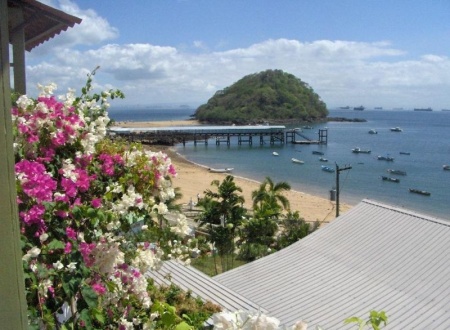
Taboga Island is located in the Panama´s Gulf, about 20 km from the city of Panama.  Part of the district bearing the same name, along with the nearby islands of  Taboguilla, Otoque, Urabá, Melons, Chama and pallets. Taboga has been identified as Flowers´s Island, because of its lush tropical vegetation that flourishes in most of the year.
 With a one-hour journey by boat from Panama City (12 nm), is one the most beautiful and exotic islands in tropical seas.  It has become a favorite of all Panamanians during the Holiday days and weekends.   In Taboga finds several beaches where you can enjoy and swim in the warm waters as safe.
Taboga has a new hotel called “Vereda Tropical”; the hotel is located on top of a cliff overlooking the beach where you can admire a beautiful view. The architectural style of Spain and Europe merge harmoniously in its 14 rooms, all with different decor inspired by various regions of the world: Peru, Greece, the Mediterranean and other countries.